- At least a paragraph reflection that describes the types of problems you really understood and why. Give at least one example.
- This entire cycle makes a lot of sense to me although it takes a bit of time to solve each problem. Using the A=Elc (A=abc) formula is fairly simple although doing more of the problems to improve my speed/accuracy wouldn’t hurt. The activity where we looked at the two different concentrations and seeing both of them vertically and horizontally.
- At least a paragraph reflection that describes the types of problems you struggled with and why. Give at least one example.
- I didn’t know/remember what a buret was so the first problem on Section 2 stumped me. Otherwise, I couldn’t find anything else that I really didn’t understand. With more practice, I think that I could easily tackle any problem.
- At least one picture of something you did in class during the week with a description of the picture.
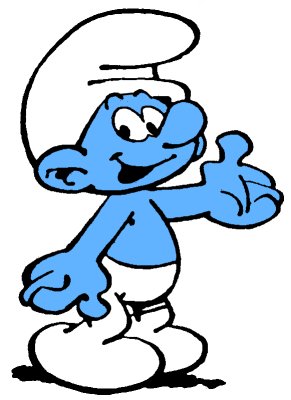
- This picture shows a situation in which 2 solutions looked the same color when looked at vertically but differently when viewed horizontally. I also have an image of a smurf since its “blood” was used in this experiment.

Thursday, December 4, 2014
Cycle D - Practice Set (Solution Properties)

Thursday, November 20, 2014
Cycle C - Practice Set (Ideal Gas Properties)
- At least a paragraph reflection that describes the types of problems you really understood and why. Give at least one example.
- The first problem which asked me to find the mole fraction of neon in the container was seemed a lot easier than I initially thought. I’m also familiar with the concept that volume occupied. I think that it’s safe to say that any problems having to do with partial pressure make a lot of sense to me. Finding molecular masses of different gas samples seemed straightforward and simple.
- At least a paragraph reflection that describes the types of problems you struggled with and why. Give at least one example.
- Finding the final pressure of an ideal gas was confusing to me since I didn’t use the approach. Determining different variables from a graph proved to be a bit challenging and a bit harder than I had expected. Overall, I had some trouble determining the numerical figures for my answers since I haven’t experienced too many of those questions. In class, we focused more on simply seeing if the numerical value was going to be greater/smaller rather than actually finding that value. I also forgot when a gas would be at STP.
- At least one picture of something you did in class during the week with a description of the picture.
- In this picture, we emptied a tea bag and then folded the bag into a cylinder shape before burning it. In this picture, the bag is in the process of burning.

Tuesday, November 11, 2014
Lone Pairs...More Important Than They Seem
Imagine a situation in which an unknown environmental agent stimulates the spontaneous loss of the lone pairs of electrons on ALL water molecules. Write a blog post that describes how this occurrence would change the face of the world as we know it. Your post must be at least 3 paragraphs and I challenge you to be as creative as possible in your description. Decide on your own title for the post. Good luck!
First off, a water molecule (H2O) is made up of an one oxygen and two hydrogen molecules. Due to its bent structure, water is a polar. This is formed due to the two hydrogen atoms pushing(arrows) towards the single O atom. However, removing the oxygen (O) atom, water would become a linear molecule. In addition, if water were to become linear, it would lose its dipole moments.
If a water molecule was to turn into a linear molecule, there would be no dipole moment. Losing the oxygen atom would cause the world to be quite strange and destructive. Water would lose its high boiling point and become increasingly easy to become flammable. Because of this, any water exposed near a flame would most likely result in an actual fire drill. Being polar, water has the ability to form London dispersion and dipole-dipole forces but without the “O”, the linear molecule would only have the potential to form the London dispersion.
Water would also become dangerous for humans to consume since we risk the possibility of being burnt every time we cook or light a match. On a hot day, all the oceans, rivers, lakes, etc. would evaporate and become as dry as the Sahara Desert. In addition, many molecules would no longer be able to latch onto water as there would only be two partially positive “heads”. To conclude, losing the lone pair is much more serious than it seems since it would turn a perfectly chemically balanced world into one where H2O is no longer usable.
Water would also become dangerous for humans to consume since we risk the possibility of being burnt every time we cook or light a match. On a hot day, all the oceans, rivers, lakes, etc. would evaporate and become as dry as the Sahara Desert. In addition, many molecules would no longer be able to latch onto water as there would only be two partially positive “heads”. To conclude, losing the lone pair is much more serious than it seems since it would turn a perfectly chemically balanced world into one where H2O is no longer usable.
Saturday, November 8, 2014
Saturday, November 1, 2014
Cycle A- Practice Set (Solubility Properties)
- At least a paragraph reflection that describes the types of problems you really understood and why. Give at least one example.
- I understand how the “like attracts like” concept works and how to distinguish which Lewis structures are polar and which are nonpolar. Problems dealing with which molecule would be most similar to H2O or any other polar/nonpolar molecule are simple. The conditions behind how a molecule is polar/nonpolar makes sense to me and are fairly easy to remember. I also understand the single/double that the molecules can make and why some are stronger/weaker than others.
- At least a paragraph reflection that describes the types of problems you struggled with and why. Give at least one example.
- I’m having some problems with distinguishing which molecule has the greater polarity (methanol or acetone). I’m also having a bit of trouble with problems having to do with isomers. I still get a bit confused when it comes to anions with charges since it changes the Lewis structure.
- At least one picture of something you did in class during the week with a description of the picture.
- This picture shows the results of a lab our group did in class of hexane being mixed with water. The hexane doesn’t mix with the water since one is polar(water) while the other is nonpolar(hexane).

Sunday, October 26, 2014
Big Idea #1 Reflection: Structure
A list of the objectives (1-16) you really understand. Include 1-2 paragraphs that details why. Do not make a reflection for each objective. Simply make one general reflection for all.
I understood all of the stoichiometry objectives since they were simply review of what I did last year in chemistry. They seemed pretty easy once I remembered what I was doing and didn’t present a problem for me. From our most recent cycle, all the material made sense to me as this seemed like the easiest cycle so far this year. The constant mass calculations were basic and very similar to stoich which made it seem easy or even easier than it already seemed.
Looking back to the previous cycles, I remember Coulomb's Law and periodicity making sense to me after a bit of review. This along with the types of types of bonds didn’t initially make too much sense but after going through my material, the process of completing these problems no longer were as difficult since I got the hang of it.
A list of the objectives (1-16) you still struggle with. Include 1-2 paragraphs that details why. Do not make a reflection for each objective. Simply make one general reflection for all.
I understand the majority of problems but some of the VSEPR and bonding structures confuse me from time to time. Otherwise, most problems are good to go except ones that are over-the-top. For example, finding the lewis structure of something ridiculously difficult or one dealing with compounds that are rarely or never used. Having more of these problems show up in the second quarter should definitely patch up any confusion.
Saturday, October 25, 2014


Subscribe to:
Posts (Atom)